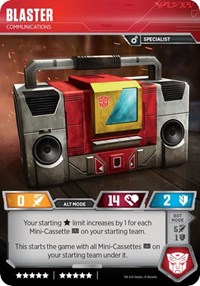
How are you supposed to combat the new orange menace that the VectorSigma crew popularized at GenCon? It has continued to run unchecked through most of the remaining Energon Invitational Qualifiers. The deck even dominated the European Open. The deck seems too over-powered.
WRONG.
Luckily you can accompany me on a dissecting journey about how to expose the weaknesses of the deck. I assure you that the deck is beatable, if you have a solid game plan and can properly identify both the strengths as well as the weakness of the deck. While it may seem at first glance that the strengths far outweigh the weaknesses, once you are able to put a chink in the Autobot armor, the entire entourage will quickly crumble.
In order to determine how to properly combat the deck, first we must identify where the deck excels
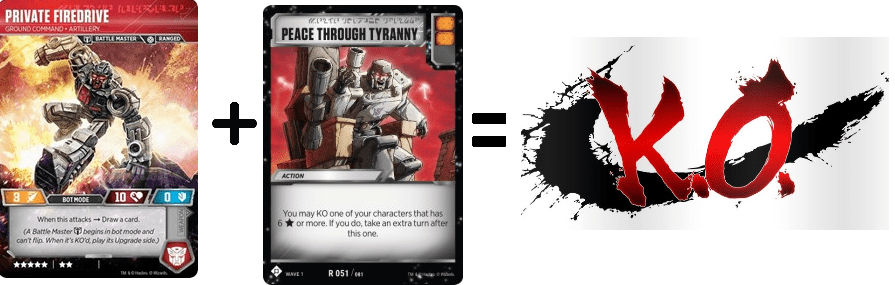
Being able to transform Firedrive into a +3 attack weapon while also generating an additional turn is quite a massive bolster to tempo. Not only will the character who is wielding Firedrive as a weapon likely KO the defender, the next turn they will be able to get the pick of the litter for targets. Great news for them, not so much for you. This sequence will lead to you most likely having two of your characters sitting out for what is left of the current game. It won’t be much of one. This also does not take into consideration any additional combat buffs they may play or additional weapons for future turns.
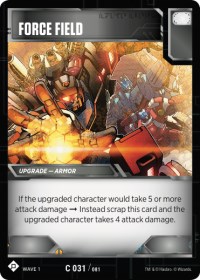
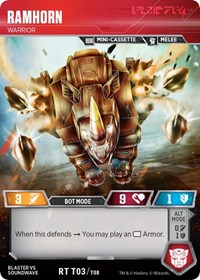
This incredibly annoying combo does an even better impersonation of Bolster. This happens to be better because it should be incredibly easy to engineer a gamestate where it is guaranteed that Ramhorn must be attacked. Note that the white armor (Forcefield, let’s not kid ourselves) does not need to be played on Ramhorn. Forcefield can be played on any of their characters. Why is this so unfair? As the attacker, you have always been able to trade one of your cards (action or upgrade) in order to answer the opponent’s stabilizing armor. Now there is not a window for you to be able to interact with this attack-nullifying armor. Forcefield can completely trivialize any attack if not destroyed beforehand. This will translate into a weak character being forced to be attacked more than previously planned or needed. It also basically generates an additional attack for the Blaster team. This subtle interaction is one of the main linchpins of the deck.
I believe that this and Bolster are the only legitimate ways to effectively lean on Forcefield as a defensive crutch. After the heavy adoption of Bashing Shields in close to 90% of decks, Forcefield’s stock decreased drastically. Now you don’t have to dedicate your offensive upgrade for a defensive one.
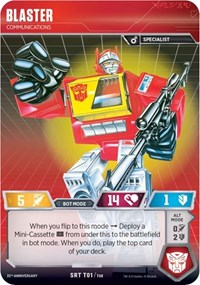
Next we must address the focal character in the deck. Having 5 attack and an effective 15 health isn’t too shabby to start with. Being able to do a small Metroplex impersonation is rather strong as well. But the largest strength to this character is his flip to bot mode ability. Having the ability to have a Field Communicator on demand is pretty strong, mostly because it does not take up any space in your battle deck. Did I forget to mention that he gets to do this twice every game? Yeah. Seems decent for 10 stars…
And lastly but certainly not least is that the deck can be easily summarized as an Autobot variant of Bugs. Meaning that it is a 4-wide aggressive deck that generates at least one extra attack while having a high pressure system to punish opponents. The inherent card advantage provided by Firedrive alongside the free cards from Blaster’s flip can make clunky draws much smoother and less susceptible to getting choked on having the most efficient turns possible.
Seems like a multitude of strengths to overcome? Most decks that are capable of winning large events have many. Another strength that I’m not going to discuss is that while this deck was running around, people had no idea how to play against it. There were play patterns that had not existed before on top of the frustration of the Metroplex deployment aspect. All this while being incased in a heavy orange shell.
I’m here to tell you how to combat this deck effectively. We don’t need to address the random aspect of Blaster’s flips because there is nothing that can be done about it (aside from killing Blaster on your first attack) so there is no point in lamenting how lucky they get when the flips come up as +4 damage buffs. It will happen but they can also be on the negative end of the variance spectrum. Just hope that RNGesus smiles upon you more than them.
Realize that the lineup doesn’t allow for much deviation or adapting. I’ll break down the turn sequence
- Flip Blaster. Deploy Ramhorn. Attack with Firedrive (possibly with Ramhorn)
- Flip Blaster to Alt mode. Attack with Ramhorn (possibly with Firedrive)
- Flip Blaster. Deploy Steeljaw. Attack with Steeljaw.
- Attack with Blaster
There are a few situations where they will attack with Ramhorn instead of Firedrive first but that should not happen often unless they are wise to your strategy.
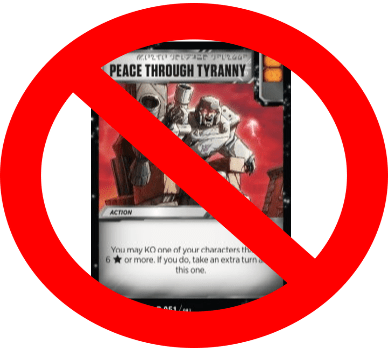
Assuming you are going second and Firedrive is a legal choice to attack, you want to try and kill him. Yes, it may seem like you are helping by giving them a weapon, and you are there is no doubt about that. Your attacker is almost assuredly going to die on the return attack. No guts, no glory. What you have managed to accomplish, however, is neutering Peace through Tyranny from here on out. Both mini cassettes are 5 stars and not eligible to be fed in order to take an extra turn. Blaster is the only character that can grant the additional turn and you are happy if they are sending him to the sidelines. The weapon is only strong in conjunction with the extra turn granted from their tyrannical actions. The weapon alone is strong enough to take out one character, but it will be a character of your choosing. There is also a chance that they choose to put the weapon on Blaster, and you may be able to find Enforcement Batons or some other way to remove it before they even get a chance to make a game swinging attack.
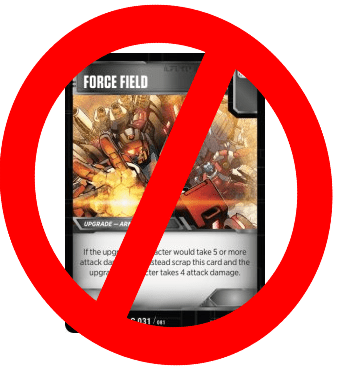
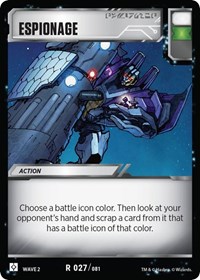
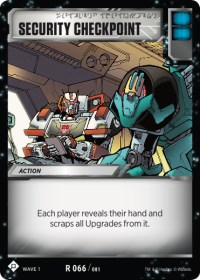
The way to combat Ramhorn is by being able to strip the Forcefield from their hand before you even attack. Espionage is the best way of singling out strictly Forcefield whereas Security Checkpoint also has further arching disruption. Granted, Checkpoint is not as strong against this particular orange aggressive deck because Firedrive can always provide the weapon for them if they can successfully funnel damage into him on their terms. I prefer Espionage mostly because Forcefield is only a huge Tempo disadvantage against other orange decks. Decks that already have access to Checkpoint are generally less susceptible to the power of Forcefield. There are outliers however, such as Sentinels or mixed pip General Optimus builds that can employ the brutal Checkpoint while still maintaining an aggressively slanted orange shell.
Depending on your lineup, the main point of contention that is always going to remain constant is the Forcefield dilemma. It is the line that you have the most interaction against. Espionage is your best bet as a sideboard choice to combat the deck. Remember that it can also focus down Peace Through Tyranny if that is an avenue that scares you more than Ramhorn.
Be cognizant of turn sequencing. If you are first, you need not fear Tyranny. They will be able to sacrifice Firedrive for a large attack on their second turn but doing so makes them lose an attack.
The characters (aside from Blaster himself) are just Autobot mirrors of Insecticons except they have weaker attack stats. Both cassettes along with Firedrive have 10 effective health. Sound like some bugs you may have battled in the past? If you can trade characters each attack, you should be favored. I imagine that you can still function a way to a win. Blaster rarely even plays Quartermaster, so once the weapon is knocked off you need not concern yourself with a singular weapon that is capable of being larger than a Grenade Launcher.
While Blaster and friends have a multitude of strengths, there are some glaring weaknesses amongst them. Being able to withstand the orange onslaught is the key. If survival isn’t in your repertoire, then being able to disrupt their strong plays will likely be enough to secure a victory for you. Don’t get discouraged with some good variance on their end. Its still an orange deck with close to unbeatable draws every now and again. The deck is good, but it is not unbeatable by any means. Know where and when to pick your battles and when to chalk it up to variance.
 Dark Confidence: Competitive TCG Analysis